

Written by Kerri Lewis | Medically reviewed by Nurse Natalia Ostrowska, RGN, INP | The Skin to Love Clinic, St. Albans | CQC regulated | Save Face accredited
Sculptra Body was designed for a particular kind of moment: when your body has worked hard for you, through the years, possibly through pregnancy, sometimes through the effort of losing weight, but your skin hasn't quite kept up. It's softer than it used to be, a little looser, maybe crepey in a way no moisturiser seems to touch. You've probably quietly wondered if this is just something you live with now.
What Is In This Blog:
Yes, for the right concern. Sculptra Body isn't a quick fix, it won't tighten skin overnight or remove fat. What it does is prompt your own skin to rebuild its collagen from within: research has shown that poly-L-lactic acid directly switches on the collagen-producing pathway inside skin cells. On the body, that gradual rebuilding is what leads to firmer, less crepey skin over the following months: real change, just one that takes patience rather than delivering an overnight transformation.
The active ingredient and the underlying mechanism are exactly the same: poly-L-lactic acid, prompting your own collagen production. What differs is why the skin needs it, and how it's used.
Facial ageing is often about volume, the gradual loss of fat and bone structure beneath the skin, alongside the same collagen decline that affects skin everywhere. Declining oestrogen is a well-documented driver of that collagen loss, the same hormonal shift behind many of the skin changes women notice through perimenopause and menopause generally. On the body, though, the areas Sculptra Body treats, the upper arms, abdomen, thighs, décolletage and above the knees, are frequently affected by something else in addition: skin that's been stretched by weight fluctuation or pregnancy, beyond what it can naturally spring back from. That's laxity from stretch, not only from time.
“In practice, that means body treatment usually needs more product and a slightly different injection approach, tailored to a larger surface area and different skin thickness than the face.” explains Nurse Natalia. “The overall rhythm is similar either way: a course of sessions spread several weeks apart, with the same gradual, months-long timeline for new collagen to build and become visible”.
Three groups tend to find their way to this treatment. The first is anyone who's lost a significant amount of weight, whether through lifestyle changes, medication, or surgery, and found their skin didn't quite keep up with the change underneath it. The second is anyone whose body has been through pregnancy, where skin over the abdomen especially has been stretched further than it can fully recoil from afterwards. The third is simply the natural effect of time: skin that's gradually lost its bounce with age, independent of any single life event.
What unites all three is the type of skin change Sculptra Body actually suits: “mild to moderate laxity, crepiness, or a loss of that "snap back" quality, rather than significant excess or hanging skin.” Nurse Natalia explains.
If your skin has stretched to the point where there's a genuine fold of excess rather than a textural change and sagging, that's a different conversation, one your consultation will help clarify honestly, and it may point toward a surgical option instead. Good general health and realistic expectations of a gradual, non-surgical treatment matter more here than any specific age or number on the scale.
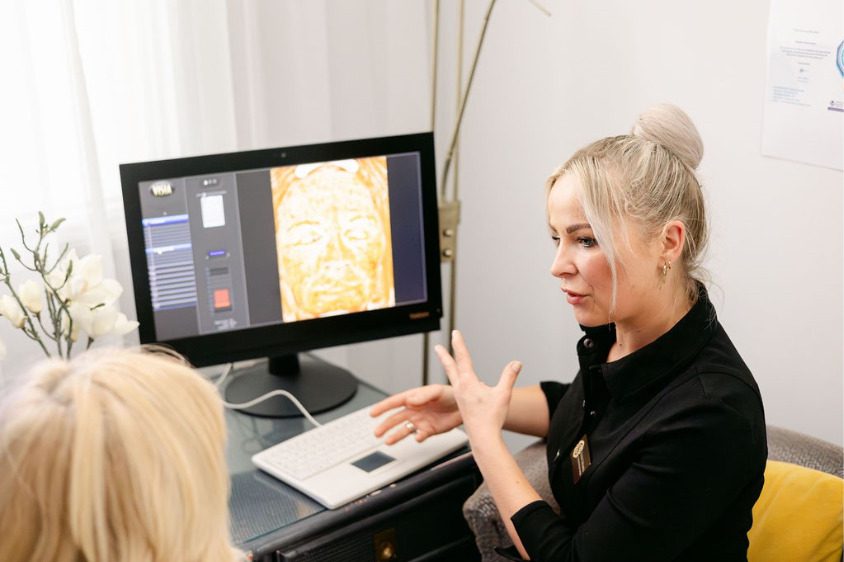
Most people need two to three sessions, spaced around four weeks apart, with two vials as the standard starting point per session. More may be needed depending on the size of the area and how much laxity there is, which we'll confirm properly at your consultation and assessment rather than guess in advance.
Results build slowly, because you're waiting for your own collagen to form rather than seeing an immediate change. A clinical trial measuring Sculptra's effect on upper-arm skin found a statistically significant increase in skin elasticity by day 90, and a significant increase in skin thickness, from 1.8mm to 2.7mm, by day 120. That timeline matches what most patients notice in practice: the most meaningful improvement usually shows around two to three months after your final session.
As for how long it lasts, the honest answer depends on which body of evidence you're looking at. Because Sculptra rebuilds your own collagen rather than sitting in the skin like a filler, results are genuinely long-lasting, because they’re legitimately you, rather than a temporary product making the changes. The clearest multi-year data comes from facial studies, where results have been shown to last up to 25 months. Body-specific studies haven't yet followed patients for quite that long, the most detailed imaging data runs to around four months, though the same biological mechanism, and our own clinical experience, both point to a similarly gradual fade rather than a sudden drop-off.
These names come up in the same conversation a lot, and it's worth being clear about what each is actually for, because they're not really competing with each other, they're solving different problems.
These names come up in the same conversation a lot, and it's worth being clear about what each is actually for, because they're not really competing with each other, they're solving different problems.
Sculptra Body vs Thermage
The biggest difference is simple: Thermage is entirely non-invasive, no needles at all. It uses radiofrequency energy to heat the deep layers of skin, tightening existing collagen immediately and encouraging new collagen over time. Sculptra Body works differently: it's an injectable, introducing PLLA that prompts your body to build entirely new collagen from scratch. “Both are aiming at the same outcome, firmer, better-quality skin, just by two genuinely different routes” says Nurse Natalia. For some patients, particularly where laxity is more pronounced, we combine the two rather than choosing between them, the same thinking behind our SculptLift protocol on the face, extended to the body.
Sculptra Body vs Emsculpt Neo
This comparison is a little more straightforward, because the two treatments aren't really aimed at the same thing. Emsculpt Neo uses electromagnetic energy and radiofrequency to build muscle and reduce fat, with an average reported 25% increase in muscle and 30% fat reduction in treated areas, according to the device's own clinical data. It changes shape and tone, so we class it as ‘body sculpting’ rather than a skin treatment. Sculptra Body doesn't touch muscle or fat at all, it changes the quality of the skin sitting over the top of it. If your main concern is loose, crepey skin, Sculptra Body is usually the direct answer. If it's more about stubborn fat or wanting more definition and tone, Emsculpt Neo is. Nurse Natalia tells us that: “Plenty of people, especially after weight loss or pregnancy, have some of both going on, in which case the two are often used together rather than as alternatives”.
Disclaimer: This blog is not to be used for diagnostic purposes. We are all unique which means that our results, recovery and suitability for any type of treatment will vary. Always seek the advice of a professional should you have any health or cosmetic concerns or to discuss treatments specifically for you.

Written by Kerri Lewis, Co-founder | Medically reviewed by Nurse Jane Lewis RN, The Skin to Love Clinic, St. Albans | CQC regulated | Save Face accredited | Published September 2026. That mark on your chest. The small rough patch on the back of your hand. The little bump just below your hairline that looks […]

10 Sep 2026

Written by Kerri Lewis, Co-founder | Medically reviewed by Nurse Natalia Ostrowska RGN and INP, The Skin to Love Clinic, St. Albans | CQC regulated | Save Face accredited | Published August 2026. You’ve slept properly. Eight hours, maybe more. No wine last night, no late one. And yet the mirror has other ideas: hollows […]

18 Aug 2026
Menu
Contact
T: 01727 837429
E: info@theskintoloveclinic.co.uk
E: feedback@theskintoloveclinic.co.uk
Feedback directly to CQC: https://www.cqc.org.uk/give-feedback-on-care
The Skin to Love Clinic
13-15 Chequer Street,
St Albans,
Hertfordshire,
AL1 3YJ


Subscribe
To receive the latest offers and updates enter your email address below to sign up to our mailing list.
You may opt out at any time.
Open© 2026 The Skin to Love Clinic | Cookie & Privacy Policy | Company Privacy Notice | Website Disclaimer | Web design by Cariad Marketing The Skin To Love Clinic Registered Address: Unit 4, Sandy Court, Ashleigh Way, Plympton, Plymouth PL7 5JX. Registered Company 08397290. VAT Reg: 162291028.


