

Skin changes caused by sun exposure are not one thing. They sit on a scale, from entirely harmless to worth acting on soon. The awkward part, and the reason this is worth five minutes of your time, is that they do not look nearly as different from one another as you would expect.
Here is what a skin specialist is often looking at.
An actinic keratosis is an area of sun-damaged skin. The British Association of Dermatologists describes them as patches that often feel rough or scaly and can look like nothing more than dry skin. They are usually pink, sometimes skin-coloured or red, and typically grow to one or two centimetres across. They tend to arrive in groups, in the places that have taken the most sun over a lifetime: forearms, the backs of the hands, the face, the ears, scalps.
“Most people find them by touch before they see them. They rarely hurt. They are very easy to explain away as dryness.” Nurse Jane tells us.
Actinic keratoses matter because they sit at the beginning of a pathway. The British Association of Dermatologists is careful with its language here, and so are we. There is a very small risk that an actinic keratosis left alone for many years could develop into a squamous cell carcinoma. Very small. But not nothing. Which is exactly why the sensible response is to have them treated early and calmly, rather than urgently later on.
Sun spots. Age spots. Liver spots. Their proper name is solar lentigines, and DermNet describes them as common, benign, flat pigmented marks on sun-exposed skin, caused by years of ultraviolet exposure.
“Benign is the important word there. Most of these marks are simply your skin's record of every summer you have ever had.” Nurse Jane explains.
Two things are still worth knowing. The first is that solar lentigines act as an independent risk marker for melanoma. Not because they turn into it, but because having a lot of them simply means your skin has had a lot of sun exposure. The second is that the list of things which can look very similar to a solar lentigo includes seborrhoeic keratosis, pigmented actinic keratosis and melanoma in situ. That is not a reason to worry about every freckle. It is the reason a flat brown mark is a poor candidate for self-diagnosis.
BCC is the most common form of skin cancer. DermNet describes it as a slowly growing plaque or nodule, skin-coloured, pink or pigmented, anywhere from a few millimetres to several centimetres across, which can bleed or ulcerate on its own.
The commonest type on the face is a small, shiny, pearl-like bump with a smooth surface, sometimes with a dip in the centre and edges that look rolled. Another type turns up as a waxy, scar-like patch whose borders you cannot quite find.
“Notice what is missing from that description. Nothing about a mole.” says Nurse Jane, “Nothing about pain. A BCC very often presents as a small shiny bump often assumed was a spot that never quite went, or a scratch that kept reopening”.
SCC behaves differently. DermNet describes enlarging scaly or crusted lumps that grow over weeks to months, can ulcerate, and are often tender or painful. They usually appear on sun-exposed skin: the face, lips, ears, hands and lower legs.
The detail worth carrying with you is this one. Nurse Jane tells us that “SCCs usually arise within a pre-existing actinic keratosis. That is the entire argument for treating those rough patches early, made in a single sentence”.
The NHS advises seeing a GP about a mole that has changed size, shape or colour, one that is painful, itchy, inflamed, bleeding or crusty, or any new or unusual mark that has not gone after a few weeks.
“Change is the signal. Not the exact appearance.” Says Nurse Jane. “If something on your skin is behaving differently to how it behaved last year, that is worth a mole check, whether or not it resembles anything on this list”.
What You Can Do At Home
Before anything else, here’s the part you can do yourself, for free, starting tonight.
The Royal Marsden recommends checking your own skin once a month. Not because you are hunting for cancer. Because you are building a baseline. The single most useful thing you can own is an accurate memory of what your skin normally looks like.
Their method is refreshingly unfussy:
That last point is quite powerful. "I think it might be slightly bigger" is not accurate information. A photograph from three months ago is.
What to look for
The NHS gives five things to notice in a mole:
The Royal Marsden offers a really simple threshold for every other lesion that’s not a mole: any abnormal patch of skin that’s not healed within four weeks, or that’s discoloured, itchy, bleeding or crusting is worth having professionally examined.
At home guides do not replace a clinical skin check, and they’re not supposed to. What these guides offer is the ability to turn your vague sense of unease about a skin lesion into something specific to act upon should you notice changes or a lesion that doesn't look or feel quite right to you.
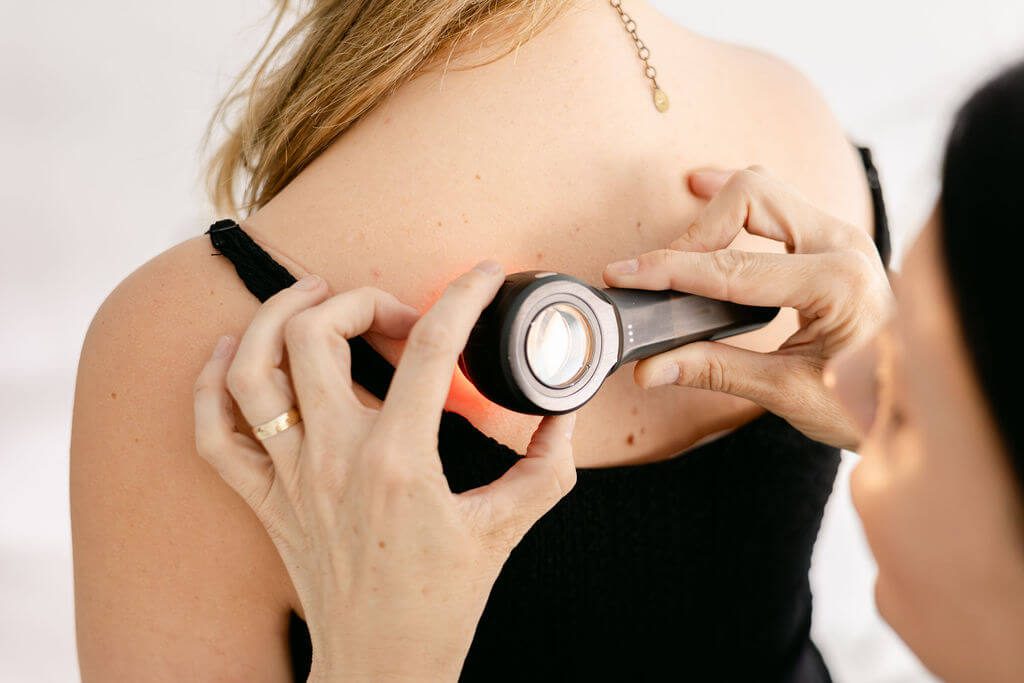
Looking at the skin, even with a well-trained and experienced eye, may need to some help to allow for an accurate diagnosis of a lesion. This isn’t a criticism of any dermatology specialist, nor is it our opinion; this comes from evidence covering 104 studies and 42,788 skin lesions, summarised by NIHR Evidence. It shows that examining skin, in person, with a dermoscope is over four rimes more accurate at identifying a melanoma than with the naked eye on its own.
Better equipped professionals do not mean more procedures. Shown across 1,000 people having their skin assessed, visual inspection without dermoscopy led to 220 unnecessary excisions. Dermoscopy led to just 44, in comparison. This finding is often the reverse of what most assume; around five times fewer people had skin cut out that never needed cutting out.
Two further findings from the same body of evidence are worth considering, whenever you eventually book a dermatology appointment:
These two points alone give you two good questions to consider before booking any skin and mole check: what will be used to examine my skin and who will be doing the examination.
The three big differences between your skin being looked at and having it fully assessed are training, the instrument used, and the ability to act quickly if a lesion needs treating.
Who examines you
A mole and skin check at our St. Albans dermatology service is carried out by Emma Kamasho, Advanced Nurse Practitioner with a Master of Science degree in Dermatology Skills and Treatment. “Emma has performed thousands of skin surgeries across the NHS and private settings since 2016” Nurse Jane, founder of The Skin to Love Clinic in Hertfordshire tells us, “She is able to clinically assess, examine, diagnose, advise, treat and onward refer where necessary”. Alongside these qualifications, skills, and experience, Emma’s career has been built in surgical theatre and dermatology, working alongside dermatologists and reconstructive surgeons throughout.
The evidence above demonstrates that experience changes what a dermoscope can do. Emma has spent over a decade building that experience.
What tool is used
A dermascope illuminates and magnifies the structure of the skin, revealing to your specialist patterns beneath the surface that the naked eye often cannot see. In practice, dermoscopy is the difference between seeing a lesion that looks brown to actually seeing how the pigment inside the lesion is arranged, for example; this is information that helps decide what happens next, if anything.
What can happen within a CQC-regulated dermatology clinic
If a lesion needs closer investigation, Emma can take a biopsy here. If a skin lesion needs removing, our minor operations suite is Care Quality Commission regulated and in use every week for this purpose, as well as to remove cosmetic skin lesions such as cysts and benign moles.
The Skin to Love Clinic hold CQC registration for the treatment of disease, disorder and injury, as well as for surgical procedures. This is a level of clinical standards and permission that very few skin clinics hold, and it’s why mole removal in St. Albans doesn’t have to mean being seen in one place and sent elsewhere to be treated. Patients travel to us from across Hertfordshire, including Hertford, Welwyn Garden City, and Harpenden, for this exact reason.
“One of the things we hear from Emma’s private dermatology patients is, I’m sure it’s nothing but I just want to be assured. And it usually is nothing. A half an hour appointment with Emma gives them a clear answer and gives them appropriate support, allowing them to stop worrying about something they’ve gradually been moving down their to-do list” says Nurse Jane.

Every review comes from a verified patient appointment who have given permission for us to share their experience in their words.
“Emma gave me complete peace of mind running a full body mole check. Her incredible knowledge and passion for skin health is undeniable. I would encourage anyone to go and visit Emma”
Freya
“Emma was so reassuring and very thorough checking my moles. The surgery she performed was carried out calmly and efficiently and the lab results were fast and thankfully all ok. I will return regularly.”
Patrick
“Every step of my treatment, removal of a basal cell carcinoma has been expertly handled by Emma. She has made me feel totally relaxed, explaining everything and given first rate care throughout.”
Mark
Book a skin check in St. Albans, Hertfordshire
A clinical skin check with Emma takes up to half an hour. In that time, you’ll receive an examination with a dermoscope, a clear explanation of what has been found, and a plan if anything needs one. If something needs investigating, a biopsy can be taken here. If it needs treating, in most cases that happens here too. If it’s nothing, which it usually is, you will find out quickly and are able to stop thinking about it.
Disclaimer: This blog is not to be used for diagnostic purposes. We are all unique which means that our results, recovery and suitability for any type of treatment will vary. Always seek the advice of a professional should you have any health or cosmetic concerns or to discuss treatments specifically for you.

Written by Kerri Lewis | Medically reviewed by Nurse Natalia Ostrowska, RGN, INP | The Skin to Love Clinic, St. Albans | CQC regulated | Save Face accredited Sculptra Body was designed for a particular kind of moment: when your body has worked hard for you, through the years, possibly through pregnancy, sometimes through the […]

7 Sep 2026

Written by Kerri Lewis, Co-founder | Medically reviewed by Nurse Natalia Ostrowska RGN and INP, The Skin to Love Clinic, St. Albans | CQC regulated | Save Face accredited | Published August 2026. You’ve slept properly. Eight hours, maybe more. No wine last night, no late one. And yet the mirror has other ideas: hollows […]
18 Aug 2026
Menu
Contact
T: 01727 837429
E: info@theskintoloveclinic.co.uk
E: feedback@theskintoloveclinic.co.uk
Feedback directly to CQC: https://www.cqc.org.uk/give-feedback-on-care
The Skin to Love Clinic
13-15 Chequer Street,
St Albans,
Hertfordshire,
AL1 3YJ
Subscribe
To receive the latest offers and updates enter your email address below to sign up to our mailing list.
You may opt out at any time.
Open© 2026 The Skin to Love Clinic | Cookie & Privacy Policy | Company Privacy Notice | Website Disclaimer | Web design by Cariad Marketing The Skin To Love Clinic Registered Address: Unit 4, Sandy Court, Ashleigh Way, Plympton, Plymouth PL7 5JX. Registered Company 08397290. VAT Reg: 162291028.


