

A cherry angioma is a small, harmless cluster of blood vessels sitting just beneath the surface of the skin. They're usually a deep red or purple, round, and only up to a few millimetres across. They're also one of the most common vascular skin changes there is, becoming noticeably more frequent from your 40s onwards, and by age 75, around three in four of us have at least one.
Nobody knows for certain why they form. What's clear is that age plays the biggest role, and researchers have also found specific gene changes, known as GNAQ and GNA11, turning up frequently in these lesions, though that research is still early days. Hormonal shifts seem to matter too: pregnancy is the clearest example, when a surge of hormones can bring several on at once.
They tend to show up on the chest, tummy, arms or shoulders, though honestly, they can appear almost anywhere. Here's the part worth remembering: a cherry angioma won't go away by itself, but it's entirely benign. It won't turn into anything else. The main practical downside is that they can bleed a little if they're knocked, scratched, or caught on clothing or jewellery, and some people are bothered by their appearance; these are usually what finally prompts people to have them looked at.
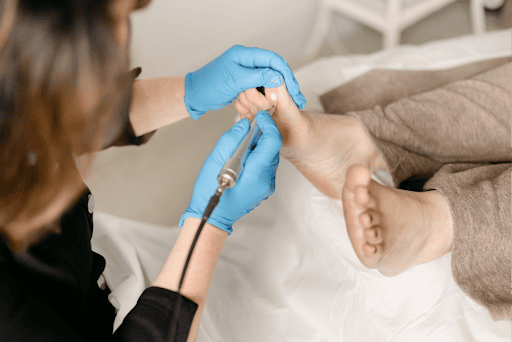
Photo shows a Regenlite Pulsed Dye Laser treatment on a vascular lesion performed by Nurse Jane Lewis at our Hertfordshire skin clinic.
Because a cherry angioma won't fade on its own, removal is really the only way to be rid of one, and it's usually a quick, simple process. At our nurse-led clinic in St. Albans, the right approach depends mainly on the size of the lesion.
For most cherry angiomas, we use a pulsed dye laser (PDL), specifically the Regenlite, which has been used on skin lesions like these for many years and works by targeting the blood vessels directly. One treatment can be all that's needed, but we will review you to assess how the lesion has responded.
Larger lesions sometimes suit a cauterisation technique instead, which applies a small amount of heat directly to the lesion to seal off its blood supply, causing it to fade. As with any device-based treatment, what matters most isn't just the brand of machine, it's an experienced practitioner using well-established equipment, which is exactly the nurse-led approach we take. There's a small chance of minor marking, such as post inflammatory hyperpigmentation, with any skin procedure like this, but this is expected to be temporary and fade.
Prices start from £75. Because the right number of sessions depends on how many lesions you have and their size, we'll always confirm this properly at an assessment rather than guessing over the phone or in a blog.
Laser Therapist Nikki Dacosta says: "Cherry angiomas are one of the most common things patients ask us to look at, and often one of the quickest to treat. Most people are pleasantly surprised by how straightforward the whole thing is."
Cherry angiomas can affect anyone, at any age, though they become far more common with pregnancy and from your 40s onwards. Whether you have just one or several, and whatever your skin type, removal is usually possible, your practitioner will tailor the approach, and the number of sessions, to what you need. If you're pregnant or breastfeeding, do let us know when you book, as we'll suggest waiting until afterwards.
Most of the time, a small red or purple mark like this is exactly what it looks like: a straightforward, harmless cherry angioma. Very occasionally, something that looks similar can turn out to be a different kind of skin change altogether, which is exactly why we don't take any lesion at face value. Before any treatment, one of our nurses will assess you to confirm what you're actually dealing with, so your treatment plan is based on a real assessment and your needs, not a guess.
That's why cherry angioma removal at The Skin to Love Clinic always starts with a redness and vascular consultation. It's your chance to have your skin examined, get a clear answer on what's there, and talk through the right removal option for you. This one isn't a straight online booking as our helpful Front of House team may need to ask you a few simply questions to ensure you’re booked with the nurse that matches your needs, so give us a call or drop us a message through our contact form and we'll get you booked in.
Disclaimer: This blog is not to be used for diagnostic purposes. We are all unique which means that our results, recovery and suitability for any type of treatment will vary. Always seek the advice of a professional should you have any health or cosmetic concerns or to discuss treatments specifically for you.

Written by clinic co-founder Kerri Lewis | Medically reviewed by Nurse Jane Lewis, RN | The Skin to Love Clinic, St. Albans | CQC regulated | Save Face accredited | HydraFacial verified provider | Published September 2026. The difference between a facial and a HydraFacial isn’t just the products and ingredients used. It’s how they […]

18 Sep 2026

Written by Kerri Lewis, Co-founder | Medically reviewed by Nurse Jane Lewis RN, The Skin to Love Clinic, St. Albans | CQC regulated | Save Face accredited | Published September 2026. That mark on your chest. The small rough patch on the back of your hand. The little bump just below your hairline that looks […]
10 Sep 2026
Menu
Contact
T: 01727 837429
E: info@theskintoloveclinic.co.uk
E: feedback@theskintoloveclinic.co.uk
Feedback directly to CQC: https://www.cqc.org.uk/give-feedback-on-care
The Skin to Love Clinic
13-15 Chequer Street,
St Albans,
Hertfordshire,
AL1 3YJ
Subscribe
To receive the latest offers and updates enter your email address below to sign up to our mailing list.
You may opt out at any time.
Open© 2026 The Skin to Love Clinic | Cookie & Privacy Policy | Company Privacy Notice | Website Disclaimer | Web design by Cariad Marketing The Skin To Love Clinic Registered Address: Unit 4, Sandy Court, Ashleigh Way, Plympton, Plymouth PL7 5JX. Registered Company 08397290. VAT Reg: 162291028.


